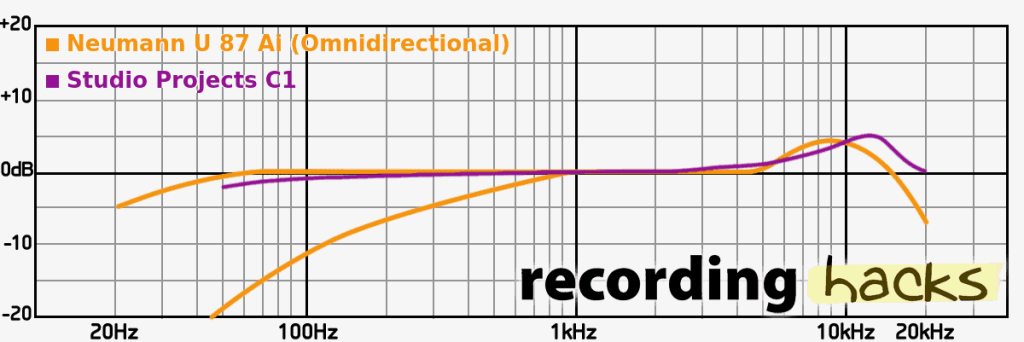
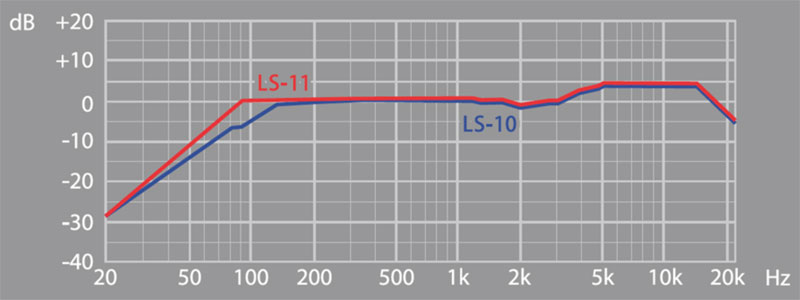
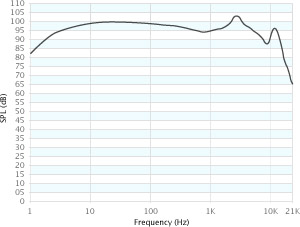
Much of the information and the images below are from the Recording Hacks website. Recording Hacks has reviews on many of the microphones we have. I have included images of the frequency response for each microphone below. Please read more at their website.
Student Blog Template
Student Samples
Mr. Le Duc’s Editing Tutorial
With and Without Pro Microphones
iPhone Sound
Pro Mic Sound
The Microphones
Studio Projects C1
- The C1 is a cardioid, large-diaphragm condenser microphone
- Compares with professional microphones costing 10 times more
- Good for many recording situations, including voice, instruments, etc.
- Read more: http://recordinghacks.com/microphones/Studio-Projects/C1

Below is the Neumann U87 for comparison with the Studio Projects C1, priced at $360, and a Neumann U87 Ai legendary microphone that is priced at over $4,600.
Shure SM58
- The SM58 is a cardioid dynamic microphone
- Perhaps the most widely known vocal mic in the world, the SM58 celebrated its 60th anniversary in 2026
- Read more: http://recordinghacks.com/microphones/Shure/SM58
- Check out the SM58 Torture Test

Shure SM7B
- The Shure SM7B is an industry-standard cardioid dynamic microphone.
- It has a reputation for being a go-to studio mic for numerous sources, including vocals.
- It is also a popular live stream, podcast, and radio microphone
- Read more: http://recordinghacks.com/microphones/Shure/SM7B

Sennheiser e609
- The e609 is a super-cardioid dynamic microphone
- Designed for recording guitar cabinets face-on and extremely close to the source
- Provides isolation from other onstage signals
- Also suitable for recording drums, especially toms
- Read more: http://recordinghacks.com/microphones/Sennheiser/e906
- Watch the overview video for guitar amp recording

Electro-Voice RE-20
- The RE-20 is a cardioid dynamic microphone
- It is designed for the radio and television broadcast market
- It is an end-address dynamic tailored for close-recorded vocals like podcasting, YouTube streaming, and close-up singing
- Read more: http://recordinghacks.com/microphones/Electro-Voice/RE20

AKG C1000S
- The C1000S is a cardioid small-diaphragm condenser microphone
- It has been used for live music, broadcast vocals, podcasting, and instrument miking
- It is called the Swiss army knife of recording
- Read more: http://recordinghacks.com/microphones/AKG-Acoustics/C-1000-S

Blue Baby Bottle
- The Baby Bottle is a pressure-gradient cardioid condenser
- Has a smooth and natural midrange and doesn’t have excessive high-end sizzle
- Read more: http://recordinghacks.com/microphones/Blue-Microphones/Baby-Bottle

SE Electronics x1s
- • The x1s is a cardioid large-diaphragm condenser microphone
- • It is an entry-level FET condenser microphone, designed specifically to outperform competitive models at a sub-$200 street price.
- Read more: https://recordinghacks.com/microphones/SE-Electronics/X1s

Microphone Polar Patterns (How the mic ‘hears’)
Polar pattern images from Wikipedia by Wikimedia Commons user Galak76
(Microphones are facing the top of the blog page)
- Omnidirectional (used to pick up ambient, public, natural sound)
- Bi-directional or Figure of 8 (used to mimic stereo sound like our ears)
- Subcardioid
- Cardioid (from the Greek καρδία “heart”)
- Hypercardioid
- Supercardioid
- Shotgun (primarily used in film)
Recording Tips
“A common problem when recording vocalists, particularly if they are more familiar with live performance than studio work, is of that they can get much too close to the microphone, causing popping, sibilance, excessive bass boost, and creating humidity problems. Very large foam windshields might help, but a separate pop shield (the nylon stocking on a wire frame idea) mounted four or five inches in front of the mic is better. An alternative technique is to rig a microphone for the vocalist to ‘eat’ with a second mic positioned something like eight inches further back and six inches higher. Normally you would record only the sound of the distant (normally a decent capacitor mic), but if you rig a conventional live-performance dynamic model as the close mic and mix in some of that mic’s signal, you can achieve a more interesting and slightly aggressive sound!”
– from 20 Tips On Using Microphones at SoundonSound.com
Microphone Terms and Concepts
- Microphones
- Dynamic – The sound waves themselves create the electrical signal by moving the membrane diaphragm of the microphone. Very popular and very well known. It is good for the low and middle range, NOT the high range.
- Condenser – The membrane has an electrical current that waits for sound. When the sound waves hit it, it responds instantly. They are all over the place, but they need an electrical charge {amplifier} from something {battery}.
- Polar Patterns
- Omni – Picks sound up from all directions equally. This is used for interviews because it can pick up more than one person, without having to have two separate mics.
- Cardioid – Picks up one half of the microphone, also known as a ‘directional mic’. Most sensitive in the front, about 180 degrees. Shaped like a heart.
- Bi-directional – ‘Figure of 8’, picks the front and behind of the mic, but the 90-degree angle on both sides does not get picked up.
- Transduction – Converts one form of energy to another.
- Voltage – An electric force or a potential difference shown in volts.
- Phantom Power – Activates the condenser in a microphone. DC powered mostly between 12 and 48 DC voltages.
- Sensitivity – Voltage at its known sound level. It can be called by its voltage or decibels. A higher number indicates greater sensitivity; most values are negative. Sound pressure.
- Frequency Response – The range of sound the microphone can produce and how sensitive it is within the range. You want it nice and flat.
- Transient – A variation in current, voltage, or frequency.
- Placement – Placement of the microphone is key; depending on the sounds you want, it can just be the distance from you or the instrument from the microphone. This part of the microphone can affect others emotionally in a way to connect with the audience.
- Proximity Effect – Decreased sensitivity to low mics, which reduces background noise and vibration, and counteracts when used very close to the source.
- Output – A place where the sound leaves the system.
- Characteristics – This is the Relative Response and Frequency measured in a Hertz graph to show how good or bad the microphone is. This can show the quality of the mic.
- Noise Rating – The signal (sound source) to noise ratio measured in decibels (dB). Noise is any sound in the background you don’t want. Electricity vibrates at 60dB, so you want the ratio of the signal and noise to be higher than that. Preferably 90dB or higher.
- Hardware
- Clips – A clip is something that you use to hold a microphone on something (for example, a stand), but using the wrong kind of clip can affect the performance; make sure it is tight so it has the correct effect.
- Stands – This ties in with a clip; this is what the clip will connect to. This keeps the microphone towards the object you want to hear without having to hold it or keep it still.
- Windscreen – Something that covers and protects the microphone, mostly a foamy material.
- Direct Box – A device used to connect an instrument directly to the audio mixer.
Other Recording Devices
Zoom H4N Digital Multi-track Recorder
- The Zoom H4N is a stereo condenser microphone recorder
- It has two microphones at 90 degree angles from each other to reproduce stereo sound
- It can be mounted on top of a camera or used separately to record sound effects, Foley, etc.
Olympus PCM LS-11 Video Tutorial
Olympus PCM LS-11
- The Olympus PCM LS-11 is a stereo condenser microphone recorder
- It has two microphones at 90-degree angles from each other to reproduce stereo sound similar to the human ear
- Read more: http://www.amazon.co.uk/Olympus-LS-11-Linear-PCM-Recorder
- Read the Users Manual and examine the best recording setting for the event
Apple iPhone, EarPods, or Cell Phone Microphones
- These microphones are probably MEMS (MicroElectrical-Mechanical System) microphones
- MEMS microphones are a type of condenser microphone
- Read more: https://en.wikipedia.org/wiki/Microphone#MEMS_microphone
 Capital High School


You must be logged in to post a comment.